Warranty and DLP
Defects Liability Period in Dubai: What Owners Should Know
By KeyDay · Published 18/09/2026 · Updated 29/09/2026 · 9 min read
9 min read
Key takeaways
- Dubai Law No. 6 of 2019, Article 40, covers installations (mechanical and electrical works, sanitary and sewerage installations and similar) for one year from handover, and structural parts for ten years from the completion certificate.
- If you do not take possession, the one-year period runs from the completion certificate instead.
- The DLP in your SPA is a contract term. Read how long it runs, what it covers and how to give notice.
- The new Civil Transactions Law, in force since 01/06/2026, keeps a separate ten-year liability of contractors and engineers for collapse and for defects that threaten stability or safety.
- Inspect in month 11 and send one written, photographed list before the period ends.
This guide is general information, not legal advice. For a dispute or a structural concern, speak to a UAE-qualified lawyer.
The defects liability period (DLP) is the time after handover during which the developer must put right defects in your home. For homes in jointly owned property in Dubai, the law sets the floor: one year from handover for defective installations, and ten years from the building's completion certificate for structural defects. Your sale and purchase agreement (SPA) may give you more, so read it alongside this guide.
What the defects liability period is
"DLP" is the name sale agreements commonly give to the developer's duty to repair defects after handover. It has two layers.
The law. For units in jointly owned property, Dubai Law No. (6) of 2019 (opens in a new tab) sets minimum periods in Article 40. The law's definition of a unit (Article 2) includes a flat, a town house and an independent house, so it reaches beyond apartment towers. Article 40 also says the law does not reduce any rights or warranties owners have against developers under other legislation.
Your contract. The SPA sets the DLP's length, what it covers and how to notify the developer. McCone Properties' handover guide (opens in a new tab) describes it as commonly a year from handover for finishes and systems. Some agreements give longer cover for particular items, so read yours closely.
If your home is not part of a jointly owned property, your SPA and general UAE law set the terms. Ask a lawyer if you are unsure which applies.
How long it runs
| Cover | Length | Starts | Source |
|---|---|---|---|
| Installations: mechanical and electrical works, sanitary and sewerage installations and similar | 1 year | Handover of the unit to you; the completion certificate if you do not take possession | Law No. 6 of 2019, Article 40 |
| Structural parts | 10 years | The building's completion certificate | Law No. 6 of 2019, Article 40 |
| The contractual DLP: finishes, fittings and workmanship, as your SPA defines them | As your SPA states; commonly 12 months | Usually handover | Your SPA |
| Decennial liability: collapse, and defects threatening stability or safety | 10 years | Delivery of the works | Civil Transactions Law, Articles 821 to 824 |
Two dates matter, so find both now: your handover date, usually on your handover certificate, and the DLP end date in your SPA. Put the end date in your calendar, with a reminder two months before it.
Note where the clock starts. Under Article 40, the one-year period for installations runs from handover of the unit to you, not from the completion certificate, unless you do not take possession.
What developers must fix
Within those periods, the developer must repair or replace defective installations and remedy structural defects, and put right whatever else your SPA covers. Defects that commonly appear once a home is lived in include:
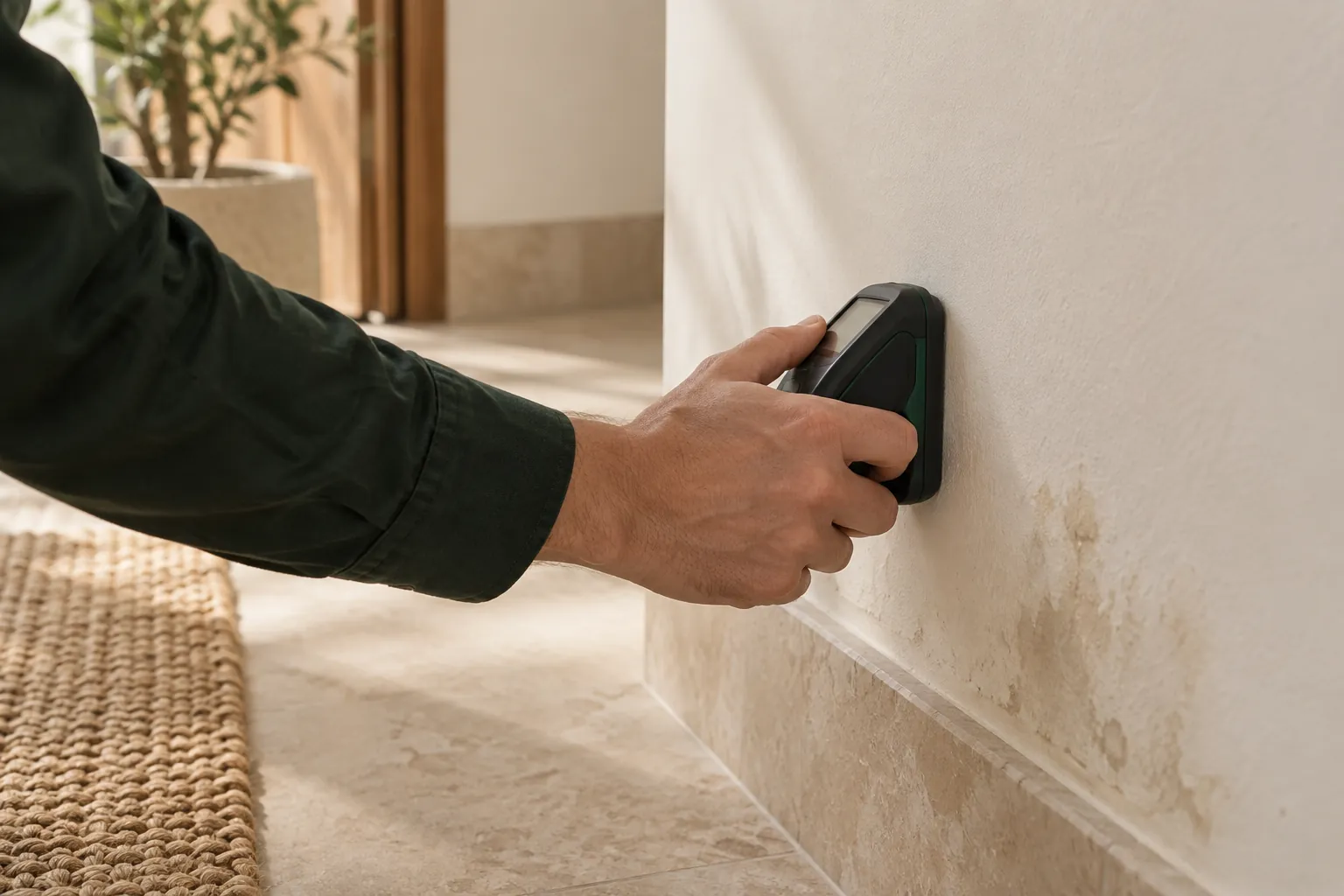
- Leaks and damp around showers, baths, kitchen sinks and air-conditioning units
- Slow or blocked drains, and floors that let water pool
- Cracked grout, failed silicone and tiles that have become hollow or loose
- Air-conditioning that does not hold temperature, drips or is noisy
- Water heaters that fail or heat slowly
- Doors and windows that stick, drop or no longer seal
- Cracks in plaster and paint, especially cracks that grow
Disagreements can arise over whether an item is a defect under your SPA, or wear and tear, misuse or an owner's alteration. Keep evidence of when you first saw each defect, and keep records of routine maintenance such as air-conditioning filter cleaning.
Defects in shared areas, such as lobbies, lifts, car parks and pools, do not belong on your personal list. Report them to the building's management, which looks after the common parts.
Decennial liability under the new Civil Transactions Law
The UAE's new Civil Transactions Law, Federal Decree-Law No. (25) of 2025 (opens in a new tab), came into force on 01/06/2026 and repealed the 1985 Civil Transactions Law (Federal Law No. 5 of 1985). Its decennial liability rules sit in Articles 821 to 824, which replace Articles 880 to 883 of the old law. As Kayrouz & Associates (opens in a new tab) summarises them, the contractor and the supervising engineer are jointly liable for ten years from delivery of the works for total or partial collapse of the building, and for any defect that threatens its stability or safety. Any contract term that excludes or limits this liability is void, and a claim must be brought within three years of the collapse or of the defect being discovered.
That liability runs between the party that commissioned the building, usually the developer, and its contractor and engineers. For an owner in a jointly owned building, the most direct protection for structure comes from Law No. 6 of 2019 and the SPA.
If you see signs of a structural problem, such as cracks that widen or new cracks in several rooms, report them in writing and take specialist advice. A snagging or DLP inspection is visual and non-destructive; it is not a structural survey.
Why a month-11 inspection matters
At handover, a home has never been lived in. By month 11 it has been through a Dubai summer of air-conditioning, daily showers and cooking, and often its first rain. Defects that were invisible at handover can show by then: a slow leak behind a shower wall, grout that has cracked, an air-conditioning unit that struggles at peak load.
Month 11 is late enough to see a year of use and early enough to report it before the period ends. We recommend booking at least 4 weeks before your DLP ends, so there is time to inspect, report and submit.
The month-11 list should also carry forward anything still open from your handover snag list. An item the developer acknowledged at handover but never fixed should not lapse quietly with the period.
A KeyDay month-11 (DLP) inspection starts with a scoping call in month 10, to review items left open at handover and anything you have noticed since. We then inspect the occupied home with our snagging method and, within 48 hours, send a claim list in Excel and PDF, ready to submit. A re-inspection after the repairs is charged at the de-snagging price. Every month-11 inspection is quoted in writing before you book; request yours.
If your handover is still ahead, the Handover Complete + Month-11 package plans the whole first year in one booking.
How to notify the developer
- Read your SPA's notice clause. It may name an address, an email or a portal, and a form of notice. Use what it says, and keep a copy.
- Write one list. Give each defect a reference, its location, a description, a photo and the date you first noticed it. A spreadsheet works well, because the developer's team can sort and assign it.
- Send it before the DLP ends, by the method in the SPA and by email, and keep proof of sending.
- Ask for written acknowledgement and a repair schedule. Log every reply, visit and repair date.
- Check the repairs. Re-inspect each item before you mark it closed.
- If items are refused or ignored, reply in writing with your evidence and take legal advice. For jointly owned property, Article 42 of Law No. 6 of 2019 gives jurisdiction over disputes about the rights and obligations in that law to Dubai's Rental Disputes Center (opens in a new tab).
Report anything urgent, such as an active leak, as soon as you see it. Do not hold it back for the month-11 list.
Keep a first-year file
One folder, paper or digital, saves time when you need to make a claim:
- The SPA, with the DLP and notice clauses marked
- The handover certificate, with the snag list attached, and the developer's acknowledgement of it
- The snag list, with the status of each item after every repair visit
- Dated photos of each defect, and of each repair
- Every email, letter and portal reference, with the dates of repair visits
- Maintenance records, such as air-conditioning servicing
The first year at a glance
| When | What to do |
|---|---|
| Handover | Snag list attached to the handover certificate; note your DLP end date |
| Months 1 to 9 | Keep a dated log of anything new; report urgent items straight away |
| Month 10 | Book the month-11 inspection; gather your log and the SPA |
| Month 11 | Inspection, claim list within 48 hours, written submission |
| Month 12 and after | Follow up the repairs in writing; re-inspect each item before closing it |
The log is easy to let slip. Keep it simple: one spreadsheet, one row per item, with a photo reference and the date you noticed it. Our Dubai handover checklist shows the format, and our snagging inspection guide explains how the list starts at handover.
If you let the home in its first year
If you let the home soon after handover, much of the first year of cover will run while a tenant lives there. Ask the tenant, or your property manager, to report defects promptly and to give the developer's teams access for repairs. A dated move-in condition report at the start of the tenancy records the home's condition on that day, which helps separate defects the developer must fix from damage that arises later.
Frequently asked questions
For homes in jointly owned property, Dubai Law No. 6 of 2019 makes the developer liable for defective installations for one year from handover, and for structural defects for ten years from the completion certificate. Your SPA may give longer cover, so check its terms.
The one-year period for installations starts when the unit is handed over to you. If you do not take possession, it runs from the date of the completion certificate. The ten-year period for structural defects runs from the completion certificate.
A developer can decline items it considers wear and tear, misuse, poor maintenance or changes made by the owner or a tenant. Check the exclusions in your SPA, and keep dated photos and maintenance records so you can show when a defect first appeared.
A full inspection shortly before the defects liability period ends, to record defects that have appeared with use. Book it for month 11, at least 4 weeks before the period ends, so there is time to inspect, report and submit your list.
For jointly owned property, the developer remains liable for structural defects for ten years from the completion certificate under Law No. 6 of 2019. Separately, the Civil Transactions Law makes contractors and supervising engineers liable for ten years for collapse and for defects that threaten stability or safety.
Approaching month 11? Tell us your handover date and DLP end date on our booking page, or message us on WhatsApp at +971 52 585 9770 (opens in a new tab). We reply with a fixed price in writing. More guides are in Handover notes, and our FAQ answers common questions.
Sources
All pages opened on 18/09/2026.
- Dubai Legislation Portal, Law No. (6) of 2019 Concerning Ownership of Jointly Owned Real Property in the Emirate of Dubai, Articles 2, 40 and 42: dlp.dubai.gov.ae (opens in a new tab)
- UAE Legislation, Federal Decree by Law No. (25) of 2025 Promulgating the Civil Transactions Law (issued 01/10/2025; in force 01/06/2026): uaelegislation.gov.ae (opens in a new tab)
- Kayrouz & Associates, "UAE Construction Law: Decennial Liability and the New Civil Code in 2026" (20/04/2026): kayrouzandassociates.com (opens in a new tab)
- Rental Disputes Center, "About Rental Disputes Center": rdc.gov.ae (opens in a new tab)
- McCone Properties, "Snagging and handover" (September 2026): mcconeproperties.com (opens in a new tab)
Keep reading.
Checklists · 18/09/2026
Dubai Handover Checklist: What to Check Before You SignA room-by-room Dubai handover checklist: what to check before handover, how to test each system, which documents and keys to collect, and what DIY misses.9 min readRead the guide →Prices · 18/09/2026
Snagging Cost in Dubai: 2026 Price GuideSnagging cost in Dubai for 2026: sourced market ranges, how firms set prices, what drives cost, what a fee should include, and how KeyDay quotes.8 min readRead the guide →Handover guides · 18/09/2026
Snagging Inspection in Dubai: The Complete Handover GuideWhen to book a snagging inspection in Dubai, what it should cover, how long it takes, what the report looks like and what happens after the repairs.10 min readRead the guide →
Handover notice in hand?
Tell us your handover date, unit type and size. We reply with your fixed price in writing.